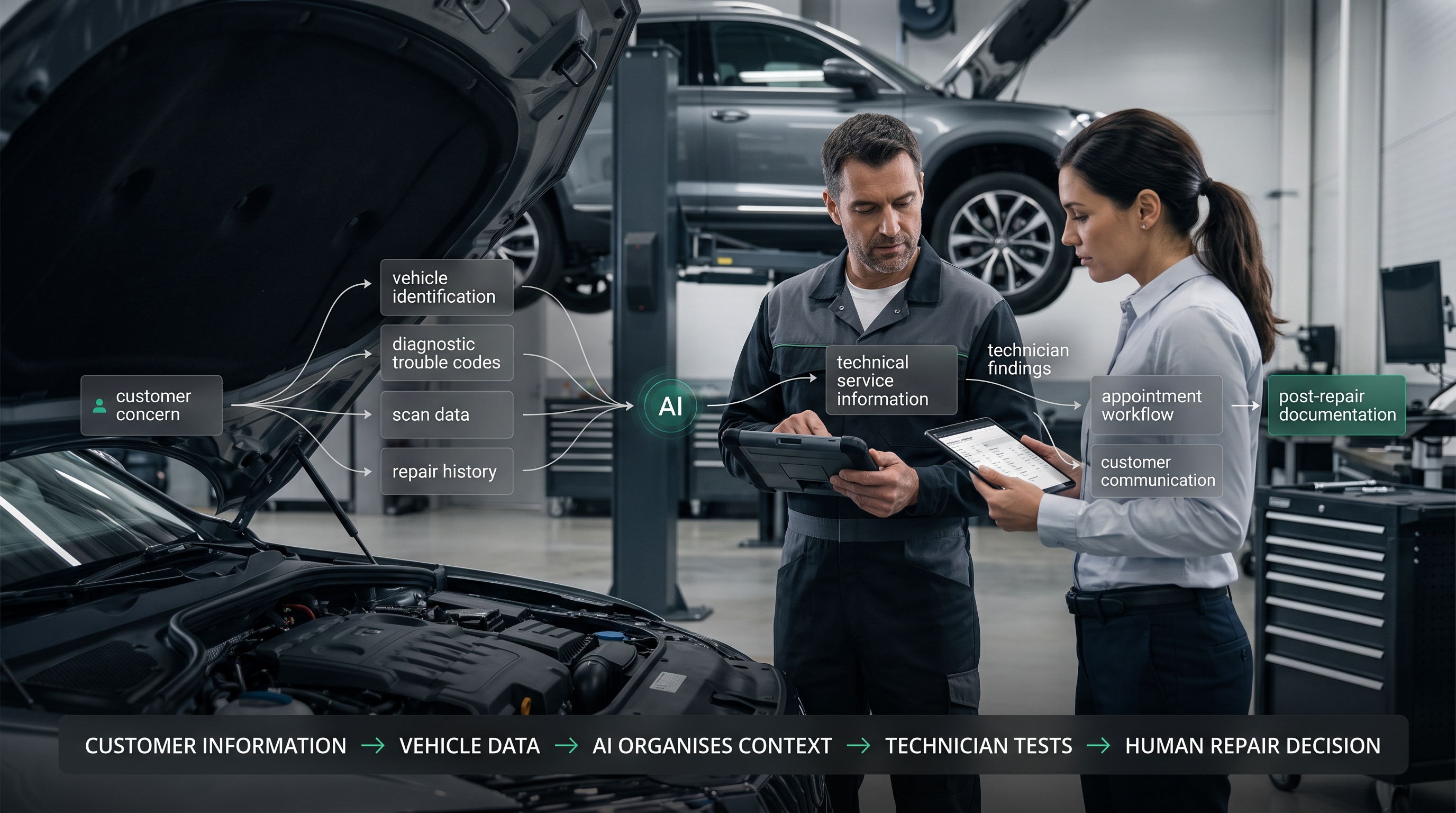
AI for auto repair shops is becoming practical in two places at once: the front counter and the service bay. On the customer side, AI can capture calls, structure appointment requests and prepare follow-up. On the technical side, it can organise symptoms, diagnostic trouble codes, repair information and technician notes so experienced people spend less time hunting through disconnected information.
The important distinction is between assistance and authority. AutoLeap now markets an AI receptionist that answers calls, captures customer and vehicle details and sends appointment requests into the shop calendar. Mitchell 1 has added scheduling and appointment-recovery features around its shop-management ecosystem. In the bay, connected diagnostic tools increasingly filter vehicle-specific codes, repair information and known fixes into a more focused troubleshooting workflow.
At the same time, the National Institute for Automotive Service Excellence has been exploring AI accreditation criteria for diagnosis and repair applications, with ASE explicitly framing AI as a tool that should enhance trained technicians rather than replace them. That is the right operating model for a repair shop.
Let AI organise the evidence and reduce repetitive work. Let technicians verify the vehicle, run the tests and own the repair decision.
1. Capture a better customer concern before the vehicle arrives
Many diagnostic problems begin with poor intake. A repair order that says “makes noise” or “check engine light” gives the technician very little to work with.
An AI-assisted intake flow can ask follow-up questions in plain language:
- When did the problem start?
- Does it happen hot, cold or all the time?
- Is the warning light steady or flashing?
- Does the issue happen during acceleration, braking, turning or idling?
- Has any recent repair work been performed?
- Is the vehicle safe to drive to the shop?
The result should not be an AI diagnosis. It should be a cleaner customer-concern record that the service advisor and technician can use.
2. Handle appointment requests and missed calls
Repair shops lose opportunities when every incoming call depends on somebody being free at the counter. Current automotive software vendors are already applying AI here because it is a relatively bounded workflow.
AutoLeap’s AIR product, for example, is designed to answer after-hours or missed calls, collect customer and vehicle details, handle routine service questions and create appointment requests. The shop still controls scheduling and the service relationship.
A sensible AI workflow can:
- capture the caller’s name and contact details,
- identify the vehicle,
- record the customer concern,
- separate routine maintenance from a diagnostic complaint,
- collect preferred dates, and
- flag urgent or safety-related language for human review.
That reduces lost information without turning the AI receptionist into a technician.
3. Draft a more complete repair order
Once intake information is captured, AI can structure it into a repair-order draft.
| Raw input | AI can organise | Human responsibility |
|---|---|---|
| Customer complaint | Convert free-form notes into a concise concern statement. | Service advisor confirms the wording with the customer. |
| Vehicle details | Attach year, make, model and VIN-derived information when licensed data is available. | Shop verifies the correct vehicle record. |
| Prior history | Summarise relevant previous repairs or recurring complaints. | Technician decides what history is diagnostically relevant. |
| Requested service | Separate maintenance request from diagnostic concern. | Advisor confirms scope and authorisation. |
A better repair order does not fix the car. It gives the person fixing the car a better starting point.
4. Organise diagnostic trouble codes and symptom context
This is where automotive AI becomes more interesting—and where shops need stronger controls.
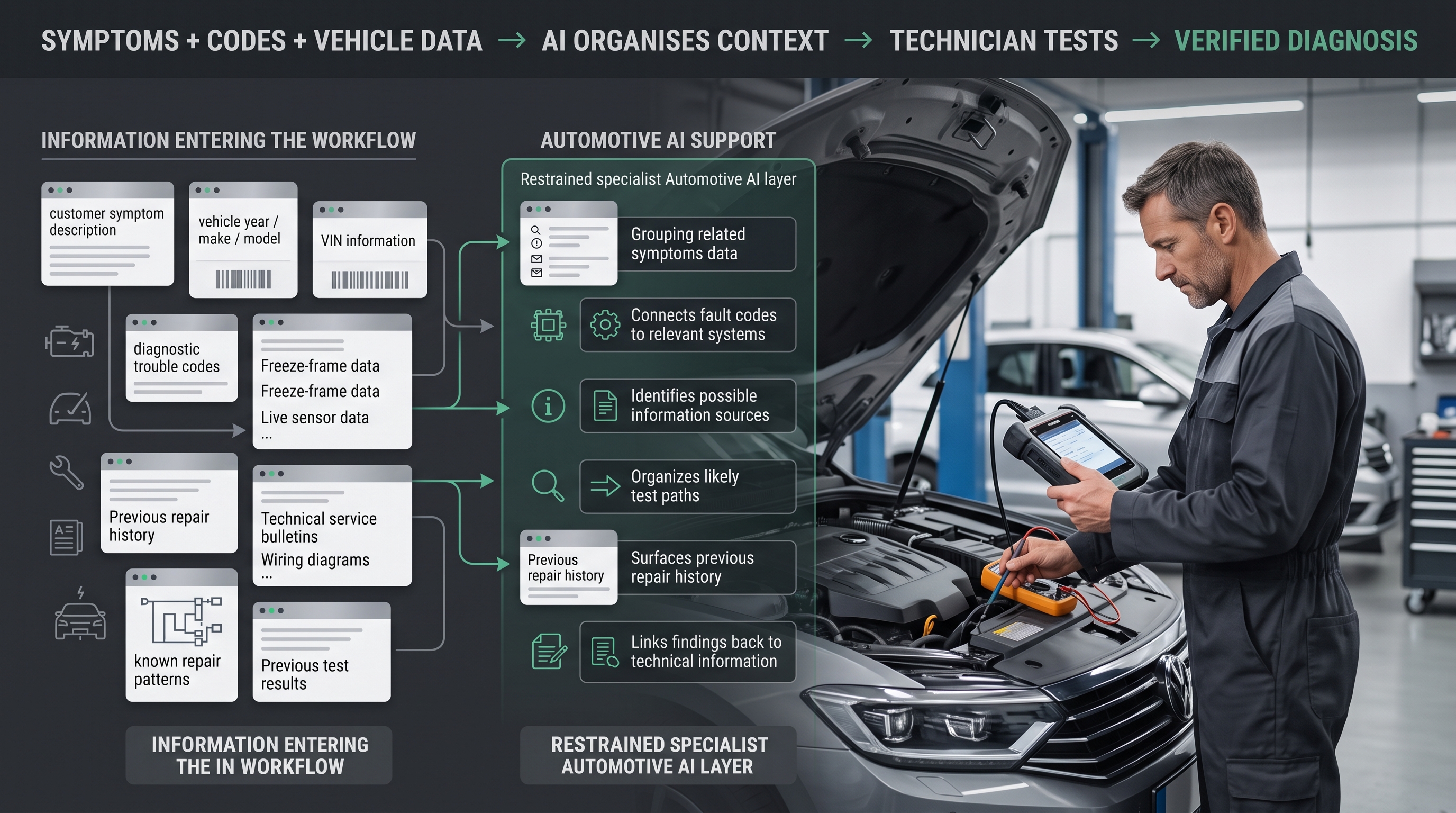
A connected diagnostic workflow may combine:
- customer symptoms,
- scan-tool codes,
- freeze-frame data,
- vehicle configuration,
- known repair patterns,
- service bulletins,
- wiring information, and
- previous test results.
AI can help organise that context and propose a sequence of checks. It should not encourage parts replacement based only on a code description.
Snap-on’s current diagnostic platform illustrates the broader direction: its Fast-Track Intelligent Diagnostics filters OEM insights, tests and experience-based information specifically to the vehicle and code being worked on. MOTOR has likewise reported that connected diagnostics and AI are increasingly being used to guide technicians through complex vehicle systems.
5. Find repair information without searching five systems manually
Technicians often lose time moving between scan tools, repair-information platforms, wiring diagrams, technical service bulletins, saved PDFs and shop notes.
A specialist automotive AI layer can improve retrieval by accepting a question such as:
- “What tests should I perform before condemning this component?”
- “Find the wiring diagram related to this circuit.”
- “Are there service bulletins relevant to this code and vehicle?”
- “What previous repairs has this shop recorded for this VIN?”
The answer should link back to the authorised source. If the shop does not license OEM or third-party repair data, the AI should not pretend that information is included.
6. Build a technician handoff when the job changes bays or people
A difficult repair may pass from a general technician to a diagnostic specialist, foreman or remote-support expert. Information is often lost during that handoff.
AI can prepare a structured technical summary containing:
This becomes especially useful as remote diagnostic support grows. Bosch’s September 2026 Remote Diagnostics Service, for example, connects technicians with Bosch diagnostic experts who can perform remote OEM scans and support more complex diagnostic or ADAS-related work.
7. Turn technical findings into a customer-ready explanation
Technicians think in codes, test results, waveforms, specifications and failure patterns. Customers usually want three answers:
- What is wrong?
- Why does it matter?
- What should we do next?
AI can convert an approved technician finding into a clearer draft explanation. For example, instead of sending a customer a diagnostic code alone, the system can draft a short explanation of the confirmed fault, what testing established it and what repair is being recommended.
The service advisor should review that message before it reaches the customer. AI should never add certainty that the technician did not establish.
8. Summarise digital vehicle inspections without hiding the evidence
Digital vehicle inspections can contain photos, measurements, notes and recommended work. AI can help organise those findings into a customer-facing summary, especially when the inspection is long.
A useful output might group findings into:
- items requiring immediate attention,
- maintenance due soon,
- monitor-only items, and
- completed checks with no action required.
The photos, measurements and technician notes should remain available underneath the summary. AI should reduce reading effort, not replace the evidence.
9. Create a cleaner post-repair record
One of the easiest AI wins is documentation after the repair has already been performed.
The system can combine technician notes, parts used, test results and final verification into a structured record:
- original complaint,
- diagnostic findings,
- repair performed,
- verification test,
- remaining recommendations, and
- customer explanation.
This helps the next technician understand what happened if the vehicle returns months later.
10. Build an internal workshop knowledge layer
Every experienced shop builds valuable local knowledge: difficult fixes, recurring vehicle patterns, preferred test sequences, equipment instructions, vendor contacts and lessons from comeback jobs.
A specialist AI system can make that knowledge searchable:
- “Have we seen this code on this engine before?”
- “Which technician solved the intermittent no-start on the last similar vehicle?”
- “Find our calibration checklist.”
- “Show the previous repair order where this test sequence was used.”
- “Which scan-tool procedure do we use before programming this module?”
The shop’s own records become a working knowledge base instead of a pile of old repair orders and technician memories.
Where automotive AI should stop
The more safety-critical the repair, the less acceptable it is to rely on a plausible-sounding answer without verification.
| Area | AI can assist | What must remain verified |
|---|---|---|
| Brakes & steering | Retrieve procedures and organise inspection findings. | Correct physical diagnosis, specifications, installation and final safety verification. |
| ADAS | Identify relevant system information and required workflow steps. | OEM procedures, target setup, environmental conditions and calibration result. |
| Airbags / restraints | Help retrieve repair information. | Manufacturer procedures and qualified technician judgement. |
| EV / high voltage | Organise service information and diagnostic context. | Required PPE, isolation procedures, measurements and trained-person requirements. |
| Programming | Prepare prerequisites and documentation. | Correct software, power support, OEM process and successful completion. |
Current industry guidance reflects this. ASE has said AI tools can become part of the technician’s toolbox, but they still require trained people and rigorous standards. Modern diagnostic platforms likewise combine filtered information with technician-led testing rather than eliminating the technician.
A practical Automotive AI workflow for an auto repair shop
- Choose one problem. Start with customer intake, repair-order drafting, diagnostic research or customer communication.
- Define approved data sources. Decide which shop-management records, scan data, licensed repair information and internal documents the AI can use.
- Separate customer statements from technician findings. Do not let the AI blur a complaint into a diagnosis.
- Require source traceability. Technical answers should point back to the repair-information source or shop record.
- Create stop conditions. Safety-critical work, missing data, conflicting test results and uncertain procedures should require technician review.
- Keep the technician approval point visible. Diagnostic conclusions and repair decisions remain human-owned.
- Pilot on completed jobs. Compare the AI output with known diagnoses and repair records before using it in live work.
- Measure time saved and corrections required. Expand only when the first workflow is reliable.
For many shops, a low-risk starting point is customer concern → structured repair-order draft → technician intake summary. It improves information quality without letting AI make the repair decision.
What to measure
Where NIR.Systems Pitwall Automotive AI fits
NIR.Systems’ Pitwall Automotive AI is an automotive-AI foundation designed around vehicle questions, diagnostic context, fault-code reasoning and workshop-oriented information.
It can be positioned for repair shops, workshops, dealerships, fleets, automotive educators, publishers or other specialist automotive services. The exact workflow depends on the audience and the data connected to the system.
The boundaries are important. OEM repair databases, VIN decoding and proprietary code or procedure libraries are not automatically included and may require separate licensed integrations. Pitwall should support technician reasoning, not be presented as a tool that can correctly diagnose every vehicle problem without inspection and testing.
Frequently asked questions
How can auto repair shops use AI today?
Useful workflows include customer intake, appointment handling, repair-order drafting, fault-code and symptom research, repair-information retrieval, technician handoffs, customer updates, post-repair documentation and internal knowledge search.
Can AI diagnose a car by itself?
AI can help organise symptoms, codes, test results and repair information, but diagnosis still depends on correct scan data, physical testing, authoritative service information and technician judgement.
Should shops use AI for ADAS or safety-critical repairs?
AI may assist with information retrieval and workflow organisation, but ADAS, braking, restraint, steering and high-voltage procedures need appropriate service information, qualified technicians, required equipment and documented verification.
Does automotive AI include OEM repair data automatically?
No. OEM procedures, VIN decoding, technical service data and proprietary repair databases often require separate licensed access. Verify exactly what the system can legally and technically use.
Sources and further reading
- ASE — AI accreditation standards for automotive diagnosis and repair
- AutoLeap — AI receptionist for auto repair shops
- Mitchell 1 — Scheduling and appointment recovery for repair shops
- Snap-on Diagnostics — Intelligent Diagnostics and repair information
- MOTOR — AI and connected diagnostics in shop workflows
- MOTOR / Bosch Diagnostics — Remote diagnostics service
Give technicians better context—not another source of guesswork.
Explore Pitwall Automotive AI for vehicle questions, fault-code reasoning, workshop information and carefully scoped automotive workflows.