
AI for real estate agents is moving beyond generic copywriting. The practical opportunity is to connect AI to repeatable agency workflows: turning verified property information into listing drafts, organising buyer enquiries, preparing viewing briefs, summarising documents, researching local market context, drafting vendor updates and helping staff find information quickly.
The UK consumer experience is already moving in this direction. Rightmove is testing AI Search and “Ask Rightmove,” allowing some users to search properties in natural language and ask questions about listings. Rightmove says its AI experience can use information supplied by estate agents and location information from Google, with source links available in some responses. That changes the standard agents are working toward: property information increasingly needs to be structured enough for both people and AI-driven search.
At the same time, UK policy is pushing in the opposite direction from “let AI make it up.” Government guidance on material information makes clear that estate agents remain responsible for providing consumers with the information they need to make informed decisions and that misleading omissions can be unlawful. The useful role for AI is therefore to organise, draft and retrieve verified information—not become a substitute for checking it.
Use AI to reduce repetitive work around property information. Do not use it to invent property facts, hide uncertainty or silently make decisions that should remain with an agent.
1. Turn verified property facts into a first listing draft
Writing a property description is an obvious AI use case, but the safe version is more structured than “write a luxury listing for this house.”
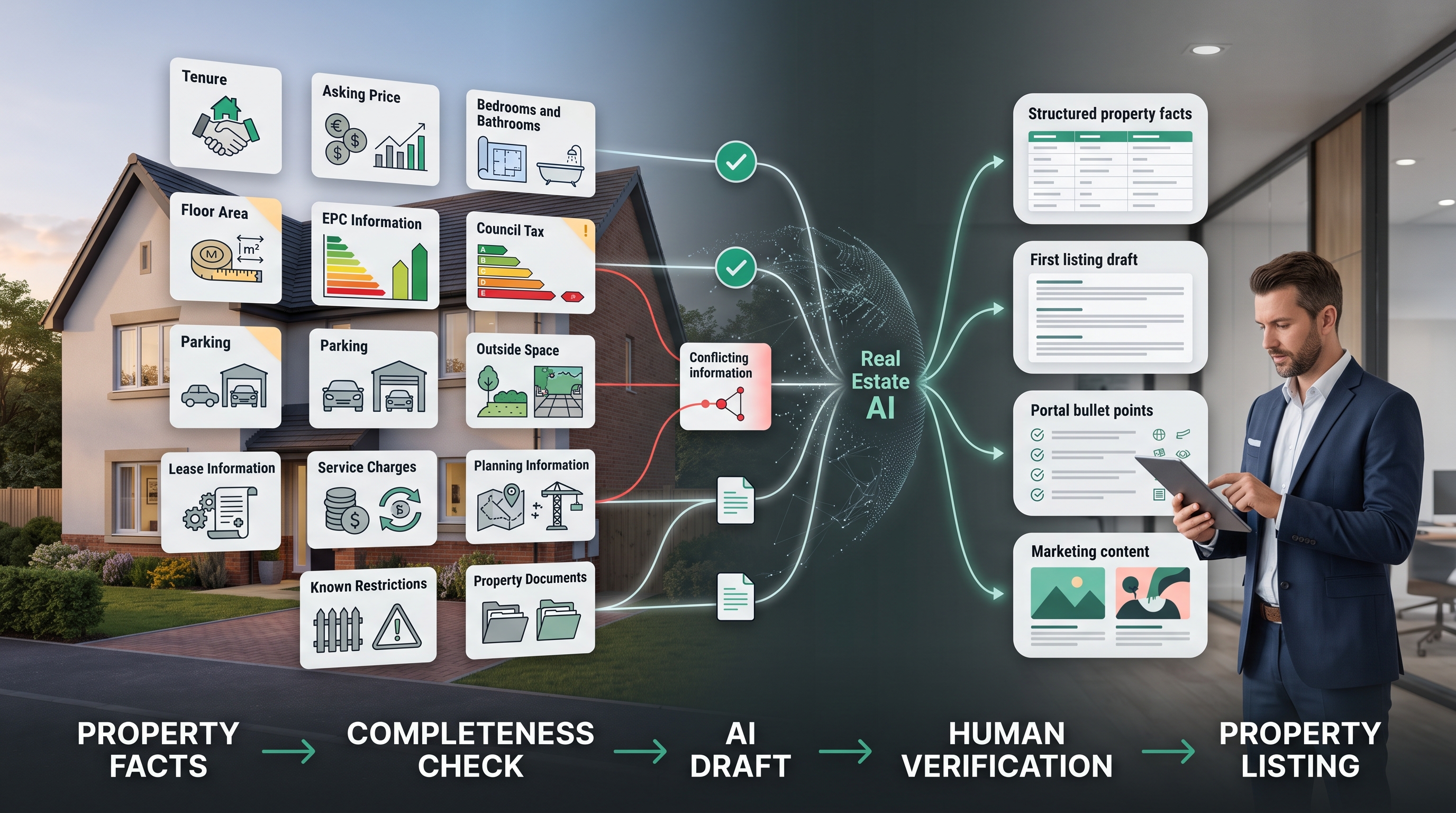
A better workflow starts with verified fields:
- property type,
- tenure,
- asking price,
- bedrooms and bathrooms,
- floor area where verified,
- EPC rating,
- council tax information,
- parking and outside space,
- lease or service-charge information where relevant,
- confirmed improvements and features, and
- material issues or restrictions that need to be disclosed.
AI can then turn those structured facts into a readable first draft, headline options, portal bullets and social snippets. The agent still checks the final text against the property file before publication.
This matters because the government’s 2026 home-buying reform work is explicitly focused on better upfront property information. Examples under discussion include tenure, council tax band, EPC rating, title information, leasehold terms, service charges, planning information, flood risk and other facts that may influence a buyer’s decision.
2. Create a material-information completeness check
One of the more valuable uses of real estate AI is not writing more copy. It is identifying what is missing before a listing goes live.
A structured system can compare the information collected for a property against the agency’s required checklist and flag gaps such as:
The AI does not decide what is legally material in every case. It acts as a completeness assistant around a workflow defined by the agency, with a human deciding what must be verified and disclosed.
3. Triage buyer enquiries without losing the human relationship
Estate agents receive repetitive questions: Is it still available? Is there parking? What is the tenure? Can I view Saturday? Is the seller in a chain? How long is the lease? Would the seller consider a lower offer?
AI can classify these enquiries and attach them to the correct property, buyer and action.
For example:
| Incoming enquiry | AI-assisted action | Human control |
|---|---|---|
| Availability question | Check current listing status and prepare a response. | Only use live status from the agency system. |
| Viewing request | Extract preferred dates and property reference. | Staff or approved booking workflow confirms the appointment. |
| Property fact question | Retrieve verified information from the property record. | Do not guess if the information is missing. |
| Offer-related message | Classify and summarise the buyer’s message. | Negotiation and seller communication remain with the agent. |
The benefit is less inbox sorting, not less personal service.
4. Prepare a better viewing brief
Before a viewing, an agent may need to recall the property’s history, seller priorities, buyer requirements, recent feedback and unresolved questions.
Real estate AI can assemble a short pre-viewing brief from the agency’s own records:
- buyer’s stated requirements,
- previous properties viewed,
- key property facts,
- seller position and agreed communication notes,
- open questions that need answering, and
- any information that must not be improvised.
This is a useful example of specialist AI because the output depends on property context and CRM history, not generic internet knowledge.
5. Turn viewing notes into structured follow-up
After a viewing, the agent may have a mixture of handwritten notes, voice notes, CRM fields and a vague memory of what the buyer liked.
A controlled AI workflow can turn those inputs into:
- a concise buyer-feedback summary,
- a draft vendor update,
- follow-up actions,
- objections or concerns to track,
- features the buyer responded to positively, and
- the next contact date.
The agent reviews the summary before it becomes part of the official CRM record or is sent to the seller.
6. Research local market context faster
Agents regularly need a first-pass view of comparable properties, asking-price changes, recent transactions, local amenities, transport, schools, development activity and wider market conditions.
AI can help organise that research—but only if the data source is appropriate. The NIR.Systems Real Estate AI foundation is designed around property research, market context, calculations and documents, but live listings or proprietary property datasets still require suitable data-provider access and licensing.
A good workflow separates three things:
- Verified property data — facts from authorised records and sources.
- Market evidence — comparables and current market information.
- Agent judgement — the professional interpretation of what those facts mean for this instruction.
AI can accelerate the first two. It should not pretend the third is automatic.
7. Summarise property and transaction documents
Residential transactions generate documents that are slow to scan repeatedly: leases, management packs, title documents, planning records, correspondence, surveys and seller-supplied forms.
An AI-assisted document workflow can extract key information, build a structured summary and flag sections for review. It should always link important conclusions back to the source document so staff can verify them.
Examples of useful extraction include:
- lease expiry and remaining term,
- service-charge figures and periods,
- restrictions or covenants that may need professional interpretation,
- management-company details,
- planning references,
- dates and parties in correspondence, and
- missing or inconsistent information.
Where legal or technical interpretation is required, the correct action is to route the question to the relevant conveyancer, surveyor or other professional—not have AI improvise an answer.
8. Produce better vendor reporting
Vendor reports are repetitive to assemble because information lives in multiple places: portal performance, enquiries, viewings, feedback, offers and agent notes.
AI can convert structured activity into a draft report such as:
The last item is important: the system can prepare observations, but pricing strategy, negotiation and advice should remain visibly owned by the agent.
9. Use AI as an internal agency knowledge layer
A growing estate agency accumulates information across CRM notes, property files, staff folders, compliance documents, templates, email threads and local-area research.
Instead of asking staff to remember where everything lives, a specialist AI system can support questions such as:
- “Which documents are still missing for 18 King Street?”
- “What feedback did we receive after the last four viewings?”
- “Show the current approved description for this property.”
- “Which seller update template do we use after two weeks on market?”
- “Find all correspondence about the lease extension.”
The useful version of this system answers from the agency’s own authorised records and links back to the source.
10. Create marketing content from approved property facts
Once the listing data is verified, the same property information can support multiple channels without rewriting everything from scratch.
AI can draft:
- portal copy,
- email campaign text,
- social captions,
- short video scripts,
- “just listed” and “under offer” posts,
- local-market updates, and
- seller-facing marketing reports.
The safeguard is simple: content generation should reuse approved information rather than create new claims about the property.
Where estate agents should be cautious with AI
Some tasks are much more sensitive than drafting or information retrieval.
| Use case | Why caution is needed |
|---|---|
| Property valuation | Data quality, methodology and professional responsibility matter. An estimate is not automatically a formal valuation. |
| Buyer or tenant ranking | Automated profiling can create fairness, transparency and data-protection issues. |
| Material-information decisions | AI may help flag missing information, but the agent remains responsible for what is provided to consumers. |
| Legal interpretation | Leases, title restrictions and contracts may require qualified legal advice. |
| Confidential client data | Generic public AI tools may not be appropriate for identity, financial or sensitive transaction information. |
| Negotiation decisions | AI can summarise evidence; the relationship and negotiation strategy belong to the agent and client. |
The Information Commissioner’s Office is updating its guidance on automated decision-making following the Data (Use and Access) Act 2025. For estate agencies, the practical lesson is that firms should be particularly careful when AI moves from assisting staff to profiling people or making decisions about them.
A practical Real Estate AI workflow for an estate agency
- Choose one workflow. Start with listing preparation, viewing follow-up, document summarisation or another repetitive process.
- Define the approved data sources. Decide which CRM records, property fields, documents and external sources the AI is allowed to use.
- Separate facts from generated copy. Keep verified property data structured and distinct from the prose AI produces.
- Define the stop conditions. Missing facts, legal questions, valuation uncertainty and sensitive personal data should trigger review.
- Add source traceability. Staff should be able to open the property record or document behind important outputs.
- Keep human approval visible. Listings, vendor advice, negotiation messages and other consequential outputs should not silently auto-publish.
- Pilot with completed or low-risk cases. Measure where the workflow saves time and where staff still have to correct it.
- Connect the next adjacent workflow only after the first one works.
For many agencies, the easiest starting point is verified property facts → listing draft → agent review → channel-specific marketing copy. It is measurable, repetitive and keeps the agent firmly in control.
What to measure
The goal is not “more AI usage.” The goal is better agency operations.
Where NIR.Systems Real Estate AI fits
NIR.Systems’ Real Estate AI foundation is designed around property research, market context, calculations, documents and jurisdiction-aware questions. It can be configured for agents, buyer’s agents, property educators, investors, publishers and other property businesses.
The useful boundary is equally important. Live property listings and proprietary market datasets require appropriate data access and licensing. Formal valuations may require licensed data, a qualified valuer or jurisdiction-specific processes. The system should therefore be configured around the actual data and professional model of the business rather than presented as a universal property oracle.
For an estate agency, the strongest use case is often a specialist layer over authorised property and CRM information: retrieve the right facts, structure the work, draft the output and make the human review point explicit.
Frequently asked questions
How can real estate agents use AI today?
Useful workflows include listing drafts, material-information checks, enquiry classification, viewing preparation, follow-up, document summarisation, market research, vendor reporting, marketing content and internal knowledge search.
Can AI write property listings for estate agents?
Yes. The safer workflow is to generate the draft from verified property facts and approved sources, then have the agent review the final listing before publication.
Should estate agents let AI value properties automatically?
AI can assist with comparable research and calculations, but an automated estimate should not automatically be presented as a formal valuation. The data, methodology, professional responsibility and local requirements matter.
What data should estate agents avoid putting into generic AI tools?
Be cautious with identity documents, financial information, sensitive correspondence, confidential transaction records and other personal data until the agency understands how the AI provider stores, accesses, retains and uses submitted information.
Sources and further reading
- UK Government — Material information in property listings
- UK Government — Home buying and selling reform roadmap
- Rightmove — AI Search and Ask Rightmove
- ICO — Automated decision-making guidance consultation
Use AI around verified property information—not instead of it.
Explore NIR.Systems’ Real Estate AI foundation for property research, documents, market context and carefully scoped real-estate workflows.