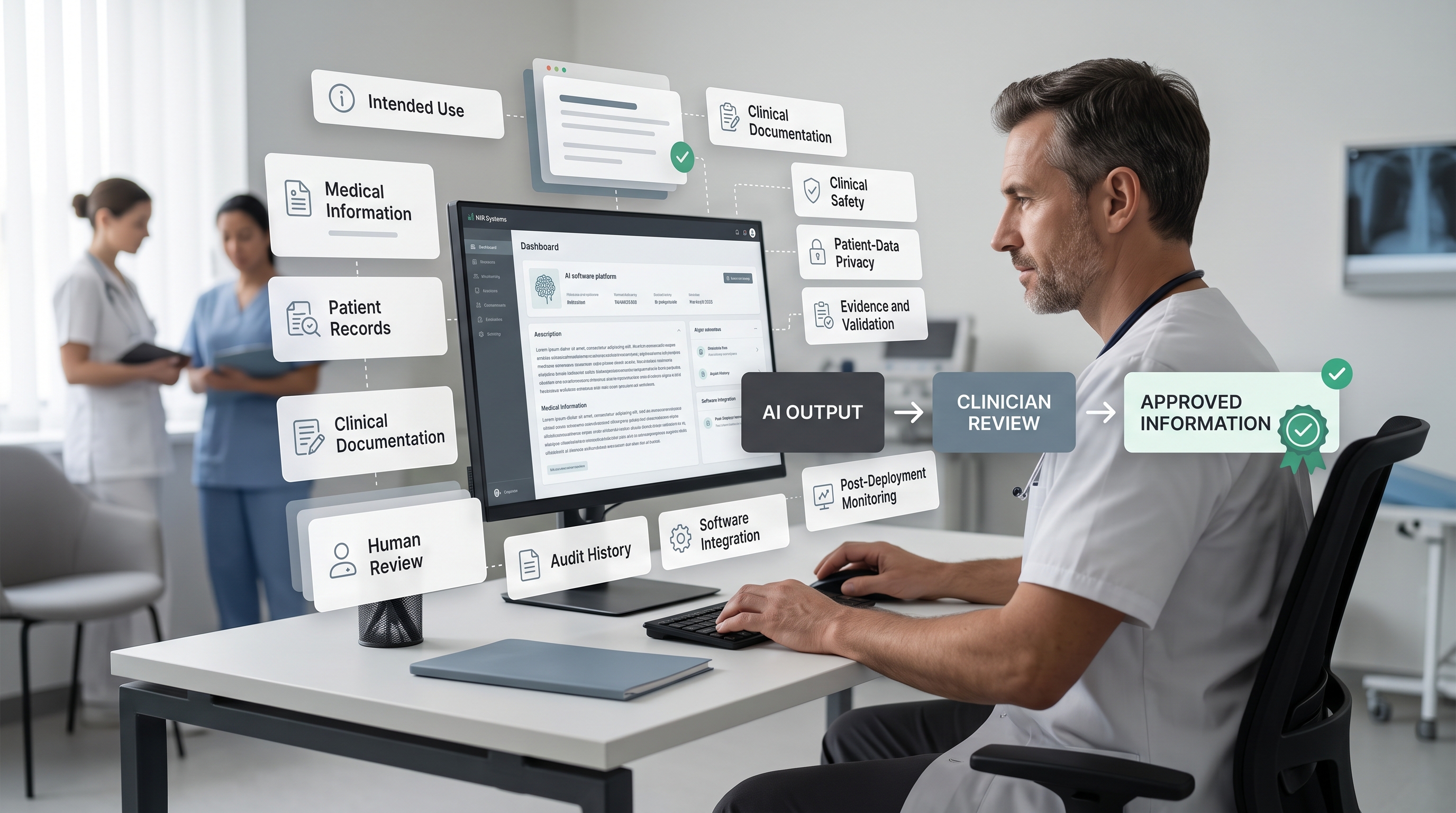
Medical AI software can now assist with tasks ranging from administration and clinical documentation to image analysis, triage, decision support and patient-information workflows. Those uses are not interchangeable. A clinic evaluating AI should therefore begin with the intended purpose and risk of the workflow—not with the sophistication of the model or how impressive the demo appears.
This matters more in healthcare than in ordinary business software because different uses can trigger different safety, privacy, professional and regulatory obligations. In the UK, the Medicines and Healthcare products Regulatory Agency (MHRA) notes that many software and AI products used in health and social care are regulated as medical devices. At the same time, not every healthcare AI product is a medical device. The regulatory position depends heavily on what the software is intended to do.
The UK’s National Commission into the Regulation of AI in Healthcare reinforced this distinction in September 2026. Its recommendations emphasise proportionate, lifecycle-based regulation and system-wide responsibility, recognising that AI products may change over time and perform differently across settings, populations and workflows.
Define the intended use first. A note-drafting assistant, a patient-information tool and software that influences diagnosis or treatment should not be evaluated as though they carry the same clinical risk.
1. Start with exactly what the AI is allowed to do
Before looking at vendors, write a one-sentence intended-use statement. For example:
- “Draft a consultation summary for clinician review.”
- “Help administrative staff classify incoming non-urgent enquiries.”
- “Explain approved patient information in simpler language.”
- “Highlight potentially relevant information from a patient record for a clinician to review.”
Those statements are materially different from:
- “Diagnose the patient.”
- “Recommend treatment automatically.”
- “Calculate clinical risk and determine the next action without review.”
NHS England’s Innovation Service explains that software is likely to be a medical device when it results in a diagnosis or prognosis, influences treatment or decision-making including risk calculation, or functions as an accessory to a medical device or medicine. That is why intended use should be established before procurement, configuration or marketing.
2. Determine whether the product is a regulated medical device
If a product’s intended purpose brings it within medical-device regulation, the clinic should not treat regulatory status as a marketing checkbox. Ask the supplier to identify the product’s intended purpose, classification, applicable conformity route and the evidence supporting its lawful placement on the UK market.
The MHRA maintains dedicated guidance for software as a medical device and artificial intelligence as a medical device. In 2026 it also expanded its AI Airlock regulatory sandbox, reflecting the fact that AI-enabled medical technologies can create regulatory questions that are different from conventional static devices.
For a clinic, useful procurement questions include:
If the answer is that the product is not a medical device, that does not mean the clinic has no safety or governance work to do. Administrative, documentation and information tools can still affect care if they introduce incorrect information, omit critical context or change staff behaviour.
3. Clinical safety has to extend beyond the vendor’s model accuracy
Model accuracy is only one component of clinical safety. A system can perform well in a benchmark and still create risk when inserted into a real clinic workflow.
In England, NHS clinical risk-management standards distinguish between the manufacturer’s responsibilities and the healthcare organisation’s deployment responsibilities. DCB0129 addresses clinical risk management in the manufacture of health IT systems, while DCB0160 addresses clinical risk management in deployment and use. NHS England states that compliance with these standards is mandatory within their relevant scope under the Health and Social Care Act 2012, and the standards are currently under review to keep pace with technologies including AI.
A clinic should therefore ask not only “Is the product safe?” but also:
- What could go wrong in our specific workflow?
- Which users could be affected?
- How could an error reach the patient?
- Which controls stop or detect that error?
- Who is responsible for reviewing residual clinical risk?
4. Human oversight must be explicit
NHS England’s current guidance for health and care professionals states that AI-based technology can support clinical work, including clinical decision-making, but the final decision about a person’s care should be made using professional judgement and in consultation with the patient or service user.
That principle should be converted into workflow design rather than left as a disclaimer.
| AI may assist | Human review point |
|---|---|
| Ambient documentation — draft notes or letters from a consultation | Clinician reviews, corrects and approves before the record is actioned. |
| Patient-information explanation — simplify approved material | Clinical governance defines the source content, limits and escalation pathway. |
| Record summarisation — organise relevant history | Clinician verifies the source record and clinically important omissions. |
| Triage support — collect and structure information | Appropriately designed clinical workflow determines escalation and accountable decision-making. |
| Decision support — flag patterns or possibilities | Qualified clinician interprets the output in the patient’s full context. |
This is not theoretical. NHS England’s 2026 ambient voice rollout describes AI-generated consultation summaries as drafts that are reviewed and validated before being actioned. That is the type of control a clinic should look for: AI reducing administrative work without silently becoming the final authority.
5. Ask what evidence supports the product in patients like yours
A clinic should distinguish between technical capability and evidence of safe, useful performance in the intended setting.
Relevant questions can include:
- What population was used to train or evaluate the system?
- Has it been tested in the same type of clinical setting?
- How does performance vary across demographic or clinical subgroups?
- What are the known failure modes?
- How often does it produce an uncertain or unusable output?
- How does performance change when data quality is poor?
- Is there peer-reviewed or independently reviewed evidence?
- What evidence applies to the current software version?
The National Commission’s September 2026 report explicitly argues for stronger lifecycle assurance and real-world evidence because AI performance can depend on deployment context and can change as products evolve.
6. Patient-data governance cannot be treated as an afterthought
Health information receives heightened protection under UK data-protection law. The Information Commissioner’s Office describes data concerning health as special-category personal data, covering not only diagnoses and treatment but also a broad range of information that reveals a person’s physical or mental health status.
Before a clinic uploads, records or routes patient information through an AI product, it should understand the complete data path.
NHS England’s information-governance guidance for AI is specifically designed to support lawful and safe use of data in health and care settings. Clinics should involve their information-governance lead, data-protection officer or equivalent governance function rather than relying solely on a vendor’s privacy page.
7. Check the product against NHS digital assurance expectations where relevant
For organisations buying digital health technologies for NHS use, the Digital Technology Assessment Criteria (DTAC) provides a useful assurance structure. NHS England’s Innovation Service describes DTAC as covering minimum expectations across clinical safety, data protection, technical assurance, interoperability, and usability and accessibility.
Even where a private clinic is not required to follow a particular NHS procurement route, those categories are still useful buyer questions:
| Assurance area | Clinic buyer question |
|---|---|
| Clinical safety | What hazards have been identified and how are they controlled? |
| Data protection | How is patient information processed, protected and governed? |
| Technical security | What assurance exists around authentication, logging, vulnerability management and cyber security? |
| Interoperability | Can the product exchange information safely with the systems we use? |
| Usability & accessibility | Can intended staff and patients use the product reliably without creating new risks? |
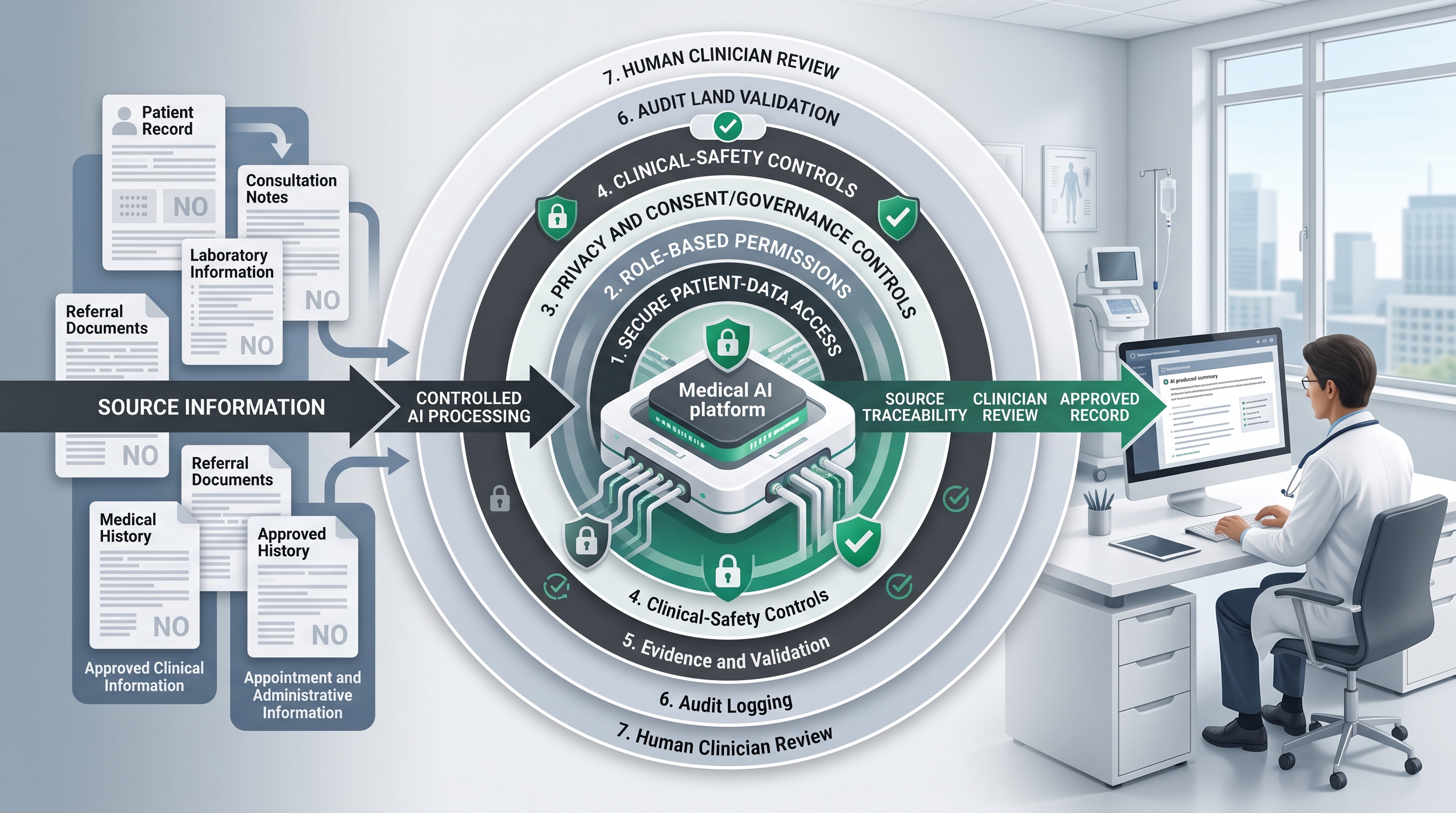
8. Integration should preserve the source of truth
Medical AI becomes harder to govern when it creates a second, disconnected version of patient information. Ask how the software interacts with the clinical system of record.
Useful integration questions include:
- Can staff see the source data behind an AI-generated summary?
- Can generated documentation be reviewed before it enters the patient record?
- Does the product preserve timestamps, authorship and audit history?
- Can the clinic control which record sections the AI can access?
- Can the integration prevent an AI draft from being mistaken for an approved clinical record?
The objective is not maximum automation. It is a clean flow between source information, AI assistance, professional review and the authoritative record.
9. Bias and subgroup performance need a real answer
Healthcare AI can perform differently across patient populations. A product may be clinically useful overall while still underperforming for particular groups, conditions or data patterns.
The clinic should therefore ask for subgroup evidence where it is relevant to the use case. The National Commission’s 2026 recommendations describe health equity as both an ethical imperative and an important part of safety and performance. The ICO also notes that organisations may need to assess and address discrimination risks in AI systems, including where special-category data is involved.
Do not accept “the model is unbiased” as a meaningful assurance statement. Ask how performance was measured, which groups were evaluated, what limitations were found and what monitoring continues after deployment.
10. Auditability matters when something goes wrong
A clinic should be able to reconstruct what happened after an unusual or harmful output.
Depending on the use case, useful audit information may include:
- which user initiated the AI workflow,
- which patient or case data was accessed,
- which model or software version generated the output,
- which source material was used,
- what the AI produced,
- what the clinician changed,
- who approved the final record or action, and
- whether the event was reported as a safety or quality issue.
This becomes even more important as AI systems move from passive assistance toward agentic workflows that can perform actions across connected systems.
11. Evaluate what happens after deployment
Traditional software procurement can encourage a “buy, implement, move on” mentality. Medical AI needs ongoing oversight because the clinical environment, user behaviour, underlying data, integrations and the software itself can change.
A clinic should define:
- who owns the AI system operationally,
- who owns clinical safety,
- who reviews incidents and near misses,
- which performance indicators are monitored,
- how software/model updates are assessed,
- when the product should be paused,
- how staff feedback is collected, and
- how patients are informed where appropriate.
This lifecycle approach mirrors the direction of the UK National Commission’s 2026 recommendations: assurance needs to continue after market entry and after local deployment, not stop at procurement.
A practical medical AI procurement workflow for clinics
- Define the problem. Identify the exact clinical, information or administrative workflow that needs improvement.
- Write the intended use. State what the AI may do and what it must not do.
- Classify the risk. Determine whether the output can influence care, safety, diagnosis, treatment or another high-consequence decision.
- Check regulatory status. Establish whether the software is a medical device for the intended use and what assurance applies.
- Review clinical evidence. Test whether the evidence matches the patient population, setting and current software version.
- Review information governance. Map patient data, access, storage, subprocessors, retention and lawful processing.
- Design the human-control point. Make clear who reviews and approves clinically relevant outputs.
- Test integration and auditability. Confirm that source records, AI drafts and approved records remain distinguishable and traceable.
- Pilot in a bounded environment. Start with a narrow workflow and monitored users rather than clinic-wide deployment.
- Measure and monitor. Track quality, errors, time saved, overrides, incidents and user feedback before expanding.
Medical AI software evaluation checklist
Where NIR.Systems Medical AI fits
NIR.Systems’ Medical AI offering is positioned as a medical-information AI foundation for careful explanations and branded health-information products. It is not presented as a guaranteed diagnostic system, and the standard branded build is not a promise of HIPAA, UK GDPR, medical-device or other regulatory certification.
That distinction is intentional. A clinic exploring non-diagnostic information or administrative use has a different risk profile from a clinic deploying software that influences diagnosis or treatment. NIR scopes the intended users, what the product must and must not do, and the safeguards required for the proposed use.
Patient-facing or clinical-decision use requires stronger privacy, clinical-safety, evidence, regulatory and governance controls. Any clinic considering such a deployment should assess those requirements for its jurisdiction and intended purpose before going live.
Frequently asked questions
What should a clinic look for in medical AI software?
Start with intended use, then assess regulatory status, clinical safety, evidence, human oversight, patient-data governance, security, integration, auditability, usability and ongoing monitoring.
Is all medical AI software a medical device in the UK?
No. The answer depends on intended purpose and functionality. Software used for diagnosis, prognosis, treatment decisions or risk calculations may fall within medical-device regulation, while some administrative or information tools may not.
Should clinicians rely on AI without checking the output?
No. NHS England guidance supports AI as an aid, but professional judgement and appropriate patient involvement remain central to decisions about care. Clinically relevant AI outputs need a defined human-review process.
Can a clinic upload patient records into any AI tool?
No. Health information is specially protected personal data. A clinic needs appropriate governance, data-protection and security arrangements and must understand how the supplier and any subprocessors use, store, access and retain that information.
Sources and further reading
- MHRA — Software and artificial intelligence as a medical device
- National Commission into the Regulation of AI in Healthcare — September 2026 recommendations
- NHS England — AI guidance for health and care professionals
- NHS England — Clinical risk management standards DCB0129 and DCB0160
- NHS Innovation Service — Digital healthcare technologies and DTAC
- ICO — Health information as special-category data
This article is general procurement and governance information, not medical, legal or regulatory advice. Requirements depend on the product’s intended purpose, deployment, patient population and jurisdiction.
Define the medical workflow before choosing the AI.
Explore NIR.Systems’ Medical AI foundation for carefully scoped medical-information and health-information experiences, with stronger safeguards required as the intended use becomes more clinically consequential.