
If you are trying to work out how to quote lawn care jobs faster, the answer is not simply a better calculator. The real improvement comes from turning the decisions already in your head into a repeatable quoting workflow.
Most slow lawn care quotes have the same problem: every enquiry starts from zero. Someone asks for mowing, edging or recurring maintenance, and the owner has to work out the property size, condition, travel, frequency, labour, extras and minimum charge all over again. The price may be reasonable, but the process is inconsistent and difficult to delegate.
Industry guidance points in the same direction. Jobber recommends creating a pricing chart before estimating individual lawn care jobs and accounting for property size, condition, additional services, labour, overhead and margin. Its 2026 pricing guide also notes that lawn care businesses commonly use flat-rate, hourly, per-area or hybrid pricing models, with recurring service packages often working differently from one-off jobs.
Do the pricing thinking once. Then let each customer enquiry supply the variables.
1. Separate your pricing model from the individual quote
Before automating anything, decide how your business actually prices the work.
Common lawn care pricing structures include:
- flat-rate pricing for defined services,
- property-size bands,
- per-square-foot or per-square-metre pricing,
- hourly pricing for uncertain work,
- recurring service packages, and
- hybrid pricing that combines a base charge with size, condition or add-on rules.
The problem is not that one model is universally better. The problem is changing the model from customer to customer without a clear reason.
Write down the rule first. For example:
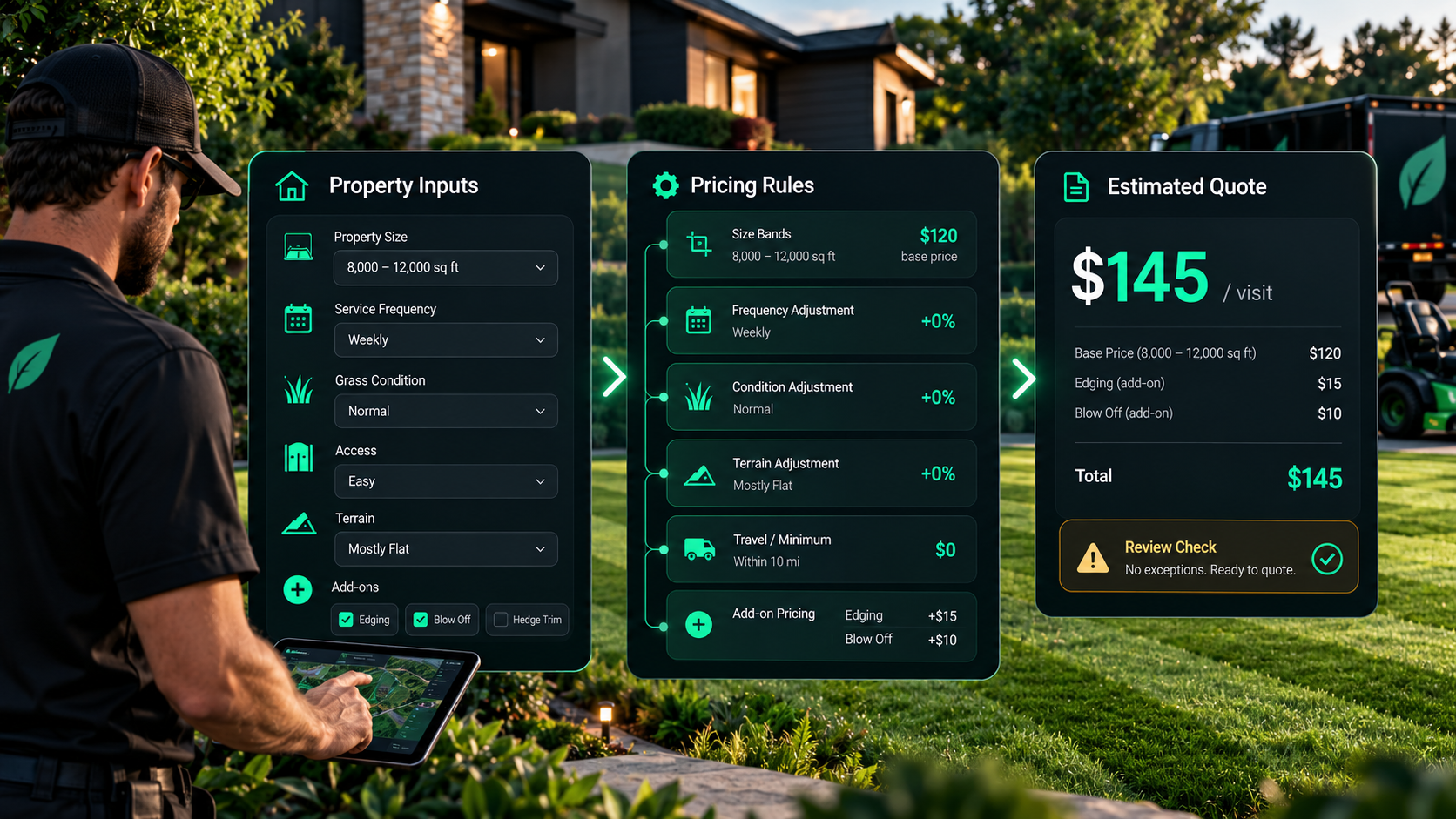
Base mowing service + property-size band + frequency adjustment + access/condition adjustment + selected add-ons = estimated price
Once that structure is defined, a quote form can collect the variables instead of asking a staff member to invent the price.
2. Build a lawn care price book
A price book does not have to be complicated. It is simply the internal source of truth for the services and pricing logic your quoting process uses.
Start with:
For each service, record the pricing basis and the conditions that change it. The point is not to copy another lawn business's rates. Your labour, equipment, route density, travel, market and service standards are different.
Jobber's estimating guidance makes the same operational point: having a written pricing chart reduces the need to decide pricing from scratch every time.
3. Ask only the questions that affect price
Long quote forms create friction. Short quote forms that omit important pricing variables create bad estimates.
The right approach is to collect only information that changes the price, determines eligibility or affects whether the job needs review.
For recurring lawn maintenance, that might include:
- service address or postcode,
- approximate lawn or property size,
- required services,
- weekly, biweekly or one-time frequency,
- grass height or current condition,
- front yard, back yard or both,
- gate width or equipment access,
- steep slopes or difficult terrain,
- obstacles such as gardens, play equipment or extensive edging,
- pet-waste or cleanup considerations where relevant, and
- optional services.
For Canada, you can store size bands in square feet, square metres or both, depending on how your customers and crews normally describe properties. Consistency matters more than the unit.
4. Use property-size bands when exact measurement is unnecessary
Many lawn care businesses do not need an exact survey-grade measurement to create a useful first estimate.
You can define bands such as:
- small,
- medium,
- large, and
- manual review.
Or use numeric bands that fit your market. The important part is that each band maps to a known pricing rule.
This makes the workflow faster because the question becomes, “Which pricing band does this property belong to?” rather than “What should we charge this person?”
5. Treat recurring and one-time work differently
A recurring customer is not operationally identical to a one-time cleanup.
Recurring jobs may have:
- more predictable grass length,
- known access,
- repeatable crew time,
- less quoting overhead, and
- better route planning.
One-time jobs may require a different rule because the initial condition is less predictable.
Your quote workflow should therefore ask service frequency early. That answer can determine which pricing logic applies.
6. Make difficult conditions explicit pricing inputs
Two lawns with the same area can take very different amounts of time.
Price-impacting conditions might include:
- long or overgrown grass,
- steep terrain,
- restricted equipment access,
- many obstacles,
- extensive trimming or edging,
- debris that needs removal,
- distant travel, and
- special scheduling requirements.
Jobber's 2026 lawn care pricing guide similarly highlights factors such as grass height, obstacles, terrain, frequency and travel distance as variables that can affect pricing.
The point is not to create dozens of hidden surcharges. It is to stop exceptional jobs from being priced as though they are ordinary.
7. Define a minimum charge
Small lawns are not free to service. Travel, unloading, equipment, administration and payment handling still exist.
A minimum charge prevents the quote engine from producing a technically calculated price that does not make commercial sense.
The minimum should come from your own economics. Once defined, it becomes another rule the system can apply consistently.
8. Use add-ons instead of rebuilding the quote
Optional work should be easy to add without restarting the calculation.
For example:
- mowing + edging,
- mowing + seasonal cleanup,
- mowing + fertilising,
- mowing + leaf removal, or
- maintenance package + hedge trimming.
Jobber's lawn care estimate template recommends detailed line items and optional services, which is useful operationally because customers can see what is included rather than receiving one unexplained number.
9. Decide when the result is an estimate and when it can be a firm quote
Speed should not create false certainty.
If the price depends on information the customer can reliably provide and the service is standardised, an automated result may be suitable as a quote.
If the property needs inspection, exact measurement or condition verification, present the result as an estimate or price guide and confirm the final amount after review.
| Situation | Suggested workflow |
|---|---|
| Standard recurring mow | Rules-based estimate or quote from defined inputs. |
| First service on an overgrown property | Estimate with condition review or photos before confirmation. |
| Large or unusual property | Route to manual review. |
| Multi-service project | Structured estimate with itemised add-ons and final confirmation. |
| Unclear access or terrain | Do not force an automatic final price; request more information. |
This distinction is important in QuoteFlow as well: the business decides whether the calculated result is presented as an estimate, guide or final quote based on how its service works.
10. Create manual-review triggers
Good automation knows when to stop.
Your system can automatically route an enquiry for review when:
This protects margin without forcing every ordinary enquiry through a manual site visit.
11. Capture the lead at the same time as the estimate
A faster quote should not create an anonymous price-checking tool that gives the business nothing in return.
The quote workflow should capture useful customer information such as:
- name,
- email or phone,
- service address,
- requested services,
- pricing inputs, and
- calculated estimate.
That is how QuoteFlow is designed: customers answer the questions your pricing depends on, the system applies configured rules rather than an AI guess, and the enquiry is captured with the estimate attached.
12. Build the follow-up workflow before launching the quote form
Fast quoting is wasted if nobody follows up.
A simple process can be:
quote completed → lead captured → business notified → review if required → call/text/email follow-up → confirm service → schedule
If the estimate is clearly within your normal range, follow-up can focus on converting the customer rather than rebuilding the price.
This principle is common in broader lawn-care software as well. Housecall Pro's current lawn-care workflow connects scheduling, quotes and payments to the same customer and job rather than transferring information between separate systems.
13. Review your pricing rules as costs change
Automation does not mean “set it once and forget it.”
Labour, fuel, equipment, disposal, materials and travel conditions change. Your quoting logic needs a review schedule.
Check:
- minimum charges,
- property-size bands,
- frequency adjustments,
- add-on prices,
- travel or service areas,
- manual-review thresholds, and
- actual job time versus quoted assumptions.
Jobber's 2026 pricing guidance specifically recommends reviewing pricing as costs such as fuel, labour and maintenance change.
How to automate lawn care quotes without losing pricing control
The safest automation model is rules-based rather than guess-based.
- Define the service. Decide exactly what standard mowing or maintenance includes.
- Define the price inputs. Property size, frequency, condition, access and add-ons.
- Build the price rules. Translate those inputs into your existing pricing logic.
- Add a minimum charge. Prevent uneconomic low prices.
- Add manual-review triggers. Identify the cases the system should not price automatically.
- Choose the output type. Quote, estimate or price guide.
- Capture customer details. Keep the estimate attached to the lead.
- Create follow-up ownership. Someone must know what happens after the customer sees the price.
- Compare quoted assumptions with completed jobs. Use actual operating results to refine the rules.
Automating a lawn care quote should mean applying your pricing rules faster—not asking software to invent the price.
A practical faster lawn care quoting workflow
A streamlined residential workflow can look like this:
- Customer chooses the service. Mowing, recurring maintenance or another defined service.
- Customer enters the property address.
- Customer selects the property-size band. Or the business uses another approved measurement method.
- Customer chooses service frequency.
- Customer answers condition and access questions.
- Customer selects optional add-ons.
- Pricing rules calculate the result.
- Minimum charge and review rules are applied.
- Customer sees the estimate or quote.
- Lead details and pricing inputs are captured.
- Your team confirms, follows up or reviews the exception.
What to measure after you speed up quoting
If the quote is faster but crews consistently exceed the assumed service time, the workflow needs better pricing rules—not more automation.
Where QuoteFlow fits
NIR.Systems QuoteFlow is built for service businesses that can express their pricing as configured rules. Customers answer the questions the price depends on, QuoteFlow calculates an estimate from those rules and captures the enquiry for follow-up.
It does not ask a general AI model to guess the price. The business controls the pricing structure and can update its rules as services, rates and minimum charges change.
For lawn care, the useful implementation is therefore not “AI, tell this customer what to pay.” It is a structured flow built around your own service catalogue, property-size logic, service frequency, condition, access and add-ons.
If you want another example of the same principles applied to a field-service business, see How Instant Online Quotes Can Help Window Cleaning Capture More Leads and the broader Quote Software for Cleaning Companies buyer guide.
Frequently asked questions
How can I quote lawn care jobs faster?
Define your pricing framework before the enquiry arrives. Create service rules for property size, frequency, condition, access, minimum charges and add-ons, then collect those variables consistently in the quote process.
Can lawn care quotes be automated?
Yes, when the service uses predictable inputs and rules. Standard recurring work is easier to automate than unusual properties, heavy cleanup or jobs that require an inspection.
Should a lawn care business use a quote or an estimate?
If the scope and inputs are sufficiently reliable, a firm quote may be appropriate. If a site inspection, measurement or condition check is still needed, present the result as an estimate or price guide until confirmed.
What information should a lawn care quote form collect?
Typical inputs include service address, property or lawn size, requested service, frequency, current condition, access, terrain or obstacles, add-ons, preferred timing and customer contact details.
Sources and further reading
- Jobber — How to Quote Lawn Mowing: 7 Steps for Estimating Profitable Jobs
- Jobber — How Much to Charge for Lawn Mowing in 2026
- Jobber — Lawn Care Estimate Template and quote structure
- Housecall Pro — Connected lawn care scheduling, quotes and payments
Turn your lawn care pricing rules into a faster customer quote.
Use the pricing logic you already trust, give customers a useful estimate sooner and capture the priced enquiry for follow-up.